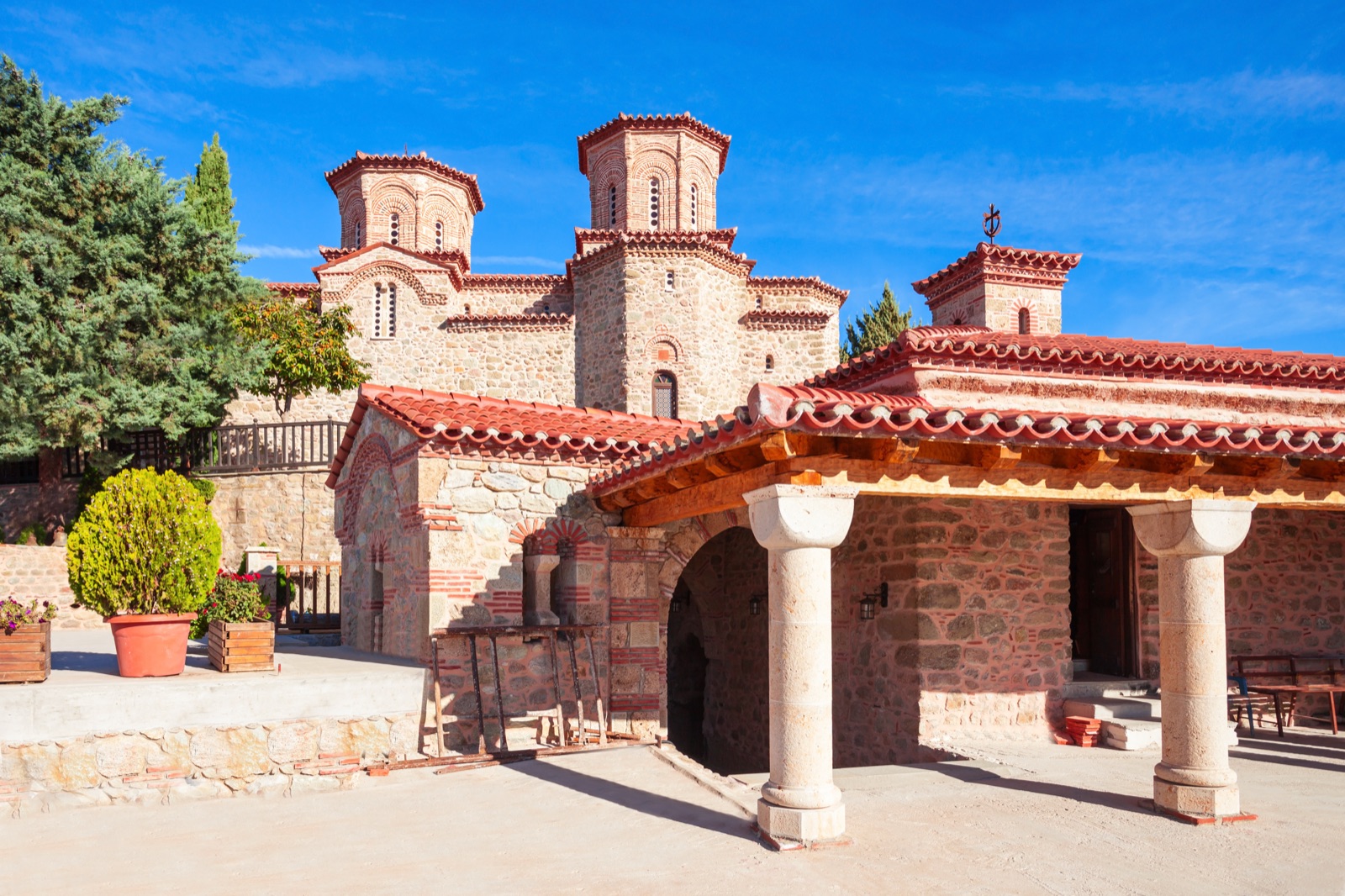
Meteora Monasteries: Opening Hours, Closing Days, Fees and Dress Code
The six monasteries of Meteora are living religious communities, and they open to visitors on their own terms. Each has its own hours, each closes on its own day of the week, and the hours change between summer and winter. Visitors who arrive without checking can find the monastery they most wanted to see shut for the day.
This guide sets out the hours and closing days of all six, the entrance fee, the dress code and the etiquette inside, and shows how to plan a visit that fits the timetable.
The six monasteries
Six historic monasteries remain active and open to visitors — four for men and two for women — out of 24 that were once active. Most of the surviving monasteries were founded in the 14th to 16th centuries, and Meteora has been a UNESCO World Heritage Site since 1988.
The six are:
- Great Meteoron
- Varlaam
- Rousanou
- St Nicholas Anapafsas
- St Stephen
- Holy Trinity
Summer hours: 1 April to 31 October
| Monastery | Opening hours | Closed on |
|---|---|---|
| Great Meteoron | 09:30 to 15:00 | Tuesdays |
| Varlaam | 09:00 to 16:00 | Fridays |
| Rousanou | 09:00 to 15:30 | Wednesdays |
| St Nicholas Anapafsas | 09:00 to 17:00 | — |
| St Stephen | 09:00 to 13:30 and 15:30 to 17:30 | Mondays |
| Holy Trinity | 10:00 to 16:00 | Thursdays |
Winter hours: 1 November to 31 March
| Monastery | Opening hours | Closed on |
|---|---|---|
| Great Meteoron | 09:30 to 14:00 | Tuesdays, Wednesdays and Thursdays |
| Varlaam | 09:00 to 15:00 | Thursdays and Fridays |
| Rousanou | 09:30 to 14:00 | Wednesdays |
| St Nicholas Anapafsas | 09:00 to 16:00 | — |
| St Stephen | 09:30 to 13:00 and 15:00 to 17:00 | Mondays |
| Holy Trinity | 10:00 to 16:00 | Thursdays |
Every Saturday and Sunday, all six monasteries are open.
These are the hours currently published. Monasteries are religious communities first, and hours can change for services and feast days, so check before you go.
What the timetable means in practice
Which day to visit
Because each monastery closes on a different day, no weekday gives you all six. A few patterns help:
- Weekends are the only days when all six are open. In winter, when Great Meteoron closes on three weekdays and Varlaam on two, a weekend visit is the surest way to see them all.
- Tuesdays: Great Meteoron is closed all year.
- Wednesdays: Rousanou is closed all year; in winter, Great Meteoron too.
- Thursdays: Holy Trinity is closed all year; in winter, Great Meteoron and Varlaam as well.
- Fridays: Varlaam is closed all year.
- Mondays: St Stephen is closed all year.
- St Nicholas Anapafsas has no closing day in either timetable.
If there is one monastery you particularly want to see, plan your day around its closing day first.
Which time of day
- Mornings give you the most choice: all the open monasteries are open by 10:00.
- Early afternoon is when the first closures come: in winter, Great Meteoron and Rousanou close at 14:00; in summer, Great Meteoron at 15:00.
- St Stephen closes in the middle of the day — 13:30 to 15:30 in summer, 13:00 to 15:00 in winter — and reopens in the afternoon.
- Late afternoon belongs to St Nicholas Anapafsas (until 17:00 in summer, 16:00 in winter) and St Stephen (until 17:30 in summer, 17:00 in winter).
A good rule is to visit the monasteries that close earliest first, and leave St Stephen and St Nicholas Anapafsas for later.
The entrance fee
Admission is €5 per monastery, paid at each entrance, in cash. There is no combined ticket: you pay at every monastery you enter. If you plan to visit three monasteries, bring €15 per person in cash, and a little more in case you add one.
The dress code
The monasteries are places of worship, and a modest dress code is enforced at the door:
- Shoulders must be covered.
- Men should wear long trousers.
- Women should wear skirts below the knee.
Wrap-skirts
Four monasteries — Great Meteoron, Varlaam, Roussanou and St Stephen — lend wrap-skirts at the entrance to women in trousers. But stock varies and queues form in peak season, so do not rely on it. The simplest approach is to dress for the monasteries from the start: a long skirt or dress and a shirt or scarf to cover the shoulders.
Why it matters
It is not a formality. Visitors who do not meet the dress code can be refused entry. Dressing appropriately is also a sign of respect for communities that still live, pray and work in these buildings.
Photography and behaviour inside
- Photography is generally allowed outdoors. Inside the churches, the rules are stricter; follow the signs and the monks’ or nuns’ instructions, and do not use flash.
- Keep your voice down. The monasteries are working communities.
- Stay in the areas open to visitors. Much of each monastery is private.
- Do not photograph monks or nuns without permission.
Getting between the monasteries
The six monasteries are spread across the rocks above Kalambaka and Kastraki, and each is reached by steps — carved into the rock in the 1920s, replacing the removable ladders and hoisting ropes that were once the only way up. Plan for some climbing at each one.
To move between them, most visitors use a local tour with hotel pickup, a taxi or a hire car; fit walkers can use the paths that link Kastraki with the rocks.
Monks, nuns and living communities
Of the six monasteries still functioning, four are communities of men and two of women. That is the most important thing to understand about a visit: you are entering someone’s home and place of prayer, not a museum.
It explains much of what might otherwise seem strict — the dress code, the closing days, the midday break at St Stephen, the areas closed to visitors. The communities open part of their monasteries to the public, and in return ask visitors to respect the life that continues inside.
Stairs and accessibility
Every monastery is reached by steps. For centuries the only access was by removable ladders or hoisting ropes; steps were carved into the rock in the 1920s, and those stairways are how you enter today. Some climbs are short, others longer and steeper.
- Allow time and energy for the stairs at each monastery, especially if you plan to visit several in a day.
- Visitors with limited mobility may find some monasteries far harder to reach than others; the viewpoints along the road offer spectacular views of all six without any climbing.
- In summer, the stairs are hot work. Visit early, carry water and take your time.
- In winter, steps can be wet. Wear shoes with a good grip.
Cash and practicalities
- Bring cash. The €5 entrance fee is paid at each monastery, in cash.
- Carry small notes and coins so you can pay quickly at the door.
- Bring water and sun protection in summer; shade is limited between monasteries.
- Keep a scarf or light shirt in your bag to cover your shoulders, even on a hot day.
- Check the hours on the day. Timetables can change for services and feast days.
Seasonal notes
Summer (1 April – 31 October) brings longer opening hours and the most flexibility. It also brings heat on the stairs and more visitors, so an early start pays off.
Winter (1 November – 31 March) brings shorter hours and more closing days — Great Meteoron closes on Tuesdays, Wednesdays and Thursdays, and Varlaam on Thursdays and Fridays. Weekends, when all six are open, are the best time to visit in winter.
In every season, the golden rule is the same: check which monasteries are open on your day before you set off.
Tours that handle the timetable
If you would rather not juggle hours and closing days, a guided tour does it for you:
The morning tour. About 4 hours, with all six monasteries seen and three visited inside, a guide plus audio guides, and pickup from your hotel in Kalambaka or Kastraki. Guides know which monasteries are open on the day.
The sunset tour. About 4 hours: all the monasteries seen from the viewpoints, the inside of one of them, the hermit caves and sunset over the rocks, with hotel pickup.
Day trips from Athens. The bus-based day trip includes a four-hour guided tour with three monasteries visited inside; the guide does not go inside with you. The Thessaloniki day trip visits two of the six.
The tours page lists them with live prices.
Choosing which monasteries to enter
With six to choose from and only a few hours, most visitors enter two or three. The timetable should make the first cut: strike off the monasteries closed on your day, then order the rest by closing time.
After that, it comes down to the experience you want:
- If you are on a guided tour, the guide will choose monasteries that are open that day and fit the route; the morning tour takes you inside three.
- If you are travelling independently, pair one monastery that closes early with one that stays open late, so a delay in the morning does not cost you both.
- If you have two days, split them by timetable: early-closing monasteries on one morning, the late-opening ones on the other afternoon.
Whatever you choose, leave time for the viewpoints between them. Seeing the monasteries from outside, perched on their pillars, is at least half the magic of Meteora.
Photographs from the viewpoints
Because photography is generally allowed outdoors, the viewpoints are where most of the best pictures are taken. Morning light and the hour before sunset bring out the texture of the rock pillars, and the sunset tour is built around exactly that. Inside the churches, respect the rules and put the camera away.
How many monasteries to visit
- Two gives you a good taste and leaves time for the viewpoints.
- Three is the number most guided tours include inside, and a comfortable half day.
- All six is possible over a weekend, when all are open, and is best spread across two days.
Remember the stairs: each monastery involves a climb, and six in a day is tiring.
A sample weekday plan (summer)
Say you are visiting on a Wednesday in summer, when Rousanou is closed:
- 09:30: Great Meteoron, open until 15:00.
- 11:00: Varlaam, open until 16:00.
- 13:00: lunch.
- 15:30: St Stephen, reopening after its midday break until 17:30.
- 16:30: St Nicholas Anapafsas, open until 17:00.
Holy Trinity (10:00 to 16:00) could replace one of these; Rousanou would have to wait for another day.
A sample summer Sunday
Sundays are a good day for Meteora because all six monasteries are open, but they are also popular. A plan that uses the summer hours:
- Early morning: Rousanou (from 09:00) and Great Meteoron (from 09:30), before the busiest part of the day.
- Late morning: Varlaam, open until 16:00, and Holy Trinity, open from 10:00 to 16:00.
- Afternoon: St Stephen after its midday break, when it reopens from 15:30 to 17:30, and St Nicholas Anapafsas, open until 17:00.
- Evening: a viewpoint for sunset, or the sunset tour.
That is all six in a day — ambitious, with a lot of stairs. For most visitors, choosing three or four and spending longer at the viewpoints makes a better day.
A sample winter weekend plan
On a winter Saturday, all six are open, but hours are shorter:
- Morning: Great Meteoron (09:30 to 14:00) and Varlaam (09:00 to 15:00) first, since they close earliest with Rousanou.
- Late morning: Rousanou (09:30 to 14:00).
- Afternoon: Holy Trinity (10:00 to 16:00), then St Stephen (15:00 to 17:00) and St Nicholas Anapafsas (until 16:00).
That is a full day of stairs; splitting it across Saturday and Sunday is more comfortable.
Frequently asked questions
What are the opening hours of the Meteora monasteries?
They vary by monastery and season. In summer (1 April – 31 October), Great Meteoron opens 09:30 to 15:00, Varlaam 09:00 to 16:00, Rousanou 09:00 to 15:30, St Nicholas Anapafsas 09:00 to 17:00, St Stephen 09:00 to 13:30 and 15:30 to 17:30, and Holy Trinity 10:00 to 16:00. Winter hours (1 November – 31 March) are shorter.
Which days are the monasteries closed?
Each closes on its own weekday: in summer, Great Meteoron on Tuesdays, Varlaam on Fridays, Rousanou on Wednesdays, St Stephen on Mondays and Holy Trinity on Thursdays; St Nicholas Anapafsas has no closing day. In winter, Great Meteoron also closes on Wednesdays and Thursdays, and Varlaam on Thursdays.
Are all the monasteries open at weekends?
Yes. Every Saturday and Sunday, all six are open.
How much is the entrance fee?
€5 per monastery, paid at each entrance in cash.
Can women wear trousers?
Women are expected to wear a skirt below the knee. Great Meteoron, Varlaam, Roussanou and St Stephen lend wrap-skirts at the entrance, but stock varies, so it is best to bring your own.
Can I take photographs?
Photography is generally allowed outdoors. Inside the churches, follow the signs and do not use flash.
How many monasteries are there at Meteora?
Six are active and open to visitors today — four of men and two of women — out of 24 that were once active.
Is there a combined ticket for all the monasteries?
No. Admission is €5 per monastery, paid at each entrance in cash.
When is the best time of day to visit?
Mornings give the most choice, since all open monasteries are open by 10:00 and some close in the early afternoon. Leave St Stephen and St Nicholas Anapafsas, which stay open later, for the afternoon.
What happens if I arrive in shorts?
You may be refused entry. Shoulders must be covered, men should wear long trousers and women skirts below the knee. Wrap-skirts are lent at four monasteries, but not reliably, so dress for the monasteries before you set out.